Wednesday, June 10, 2020

Let's Talk About Race

With so much going on in our world right now, it can be difficult to find the best way to explain these events to our children. I will be the first to admit that I still have a lot to learn. I have been sitting back and watching, reading, listening, and reflecting on all recent and not-so-recent events. I've been in full "education mode" here. 

In the only way I know how, I wanted to create some content that parents can use with their children at home. Feel free to download and use any or all parts of this freebie pack. You will need some craft supplies, a computer with internet access, and an invitation for open dialogue with your family. 

I was inspired by a read aloud shared by The Tutu Teacher on YouTube. You can find (and will need) her video which can be found HERE or below. 

I came up with a few activities for young children that could be done with the help of an adult. I also included helpful links and additional resources for kids and parents to navigate this sensitive topic. 


Activity #1 is a must if you choose to do activities #2 or #3.  The Tutu Teacher does a great job of explaining racism and race to young children. She challenges kids to "take off their skin" and get to know someone without judging them based on the color of their skin. 

Activity #2 - Have children decorate their "person" to represent themselves. Attach the skeleton page to the back of their artwork by using tape or staples. Reiterate that without our skin, we would look exactly the same on the inside. Take the papers over to a window and hold up to the light to reveal the skeleton underneath their self-portraits. This is a good time to also talk about how what is inside is the most important when learning about someone's story because the color of their skin and their appearance is only one small part of that. 

Activity #3 - In the read aloud, the story talks about how everyone has a story...elements of their lives that make them who they are. This activity challenges your child to really think about the things that make up their story. I included some questions that may help get the ball rolling, but encourage them to really dig deeply and think about who they are as a person. I also took this opportunity to discuss how their are parts of our stories that make us unique, but also that can connect us with others. The color of our skin doesn't mean that we can't relate or have things in common with others that look different than us. 

Activity #4 - I included some questions and statements to help get the conversations started with your family. There are plenty others online if you choose to look for more. 

Ready to get started???????

Just visit my store and download everything you need. Ready to print and use. 

I just started with my little guy and here is a sample of activity #3 (My Story). 


Good luck and let me know how it goes!

CLICK THE PURPLE LINK BELOW!!!!!!!!!!!!!!!!!!!!!!!!!!!!!!


Love, 
Mary

Friday, May 29, 2020

Snappsy the Alligator Freebie


I have always loved Storyline Online. It was a great option for my students if they finished work early or if we had a few minutes before dismissal that we needed to fill. I have always wanted to do read alouds of my favorite books and post them on a platform like YouTube, but there are way too many rules regarding copyright that I don't want to infringe. One positive that has come from this pandemic is that many publishers are now allowing this without any issue in order to help teachers work from a digital setting. Most publishers have set an expiration date on this favor though, and I am way too forgetful to remember to delete anything I have posted.

I figured the next best thing would be to use Storyline Online. There you can find uploaded videos of famous actors reading some absolute classics. They even now include lesson ideas! I chose to provide some extension activities for a super cute story called Snappsy the Alligator (Did Not Ask to Be in This Book) read by "Hopper" from Stranger Things. The activities provided could be appropriate for a younger age range - Pre-K with help from an adult through 2nd grade. Feel free to download from my TPT store! The link is at the BOTTOM of this post.


Activities from my packet include...

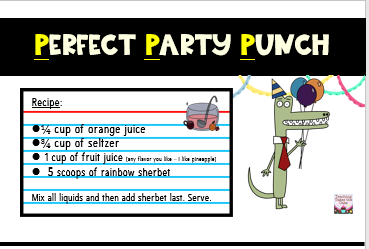
Recipe


 Roll-a-shape Game with Die Template


 3D Shape Sort


 A Scattergories-like game (easily adaptable for older kids):

Visit my Teachers Pay Teachers Store HERE to download this packet for FREE

Thursday, May 28, 2020


So my hubby and I have been quarantining with our two kids...young kids...young boys to be exact. We have been having to find ways to fill our days without turning to the trusty old screen of the iPad or TV. My MIL killed it in the gift department for our 4 year old this year and purchased a subscription to National Geographic Little Kids magazine. We received our first issue this week and it has been a huge hit!

In light of recent events (and partially because my inner teacher has just been itching to contribute), I created a few activities to accompany both the magazine and their website. You do not need a subscription to the magazine to do these activities...it's just an added bonus. 

I tailored the activities to fit a younger crowd (think preschool-kindergarten), but the video material provided by National Geographic is appropriate for much older kids too. 

Feel free to print and complete at your own pace. Share with anyone that you feel may need a filler for their day with young ones...we are in this together! #teamtruth #teamIgotyourback #quaranteam #whatdayisit

Thursday, March 1, 2018

Ugh...not more math.

     As I was growing up, I can vividly remember my hatred for math. It never came easy for me. I somehow managed to always do well enough, but God did I loathe numbers and anything that involved problem solving. The one math area that I did actually enjoy in elementary school was learning about data and measurement. Finally...visuals! Pictures! Hands-on concepts! Manipulatives that made sense to me! 

     When I became a teacher, I promised myself and my students (both current and future) that I would always try to make math fun. I would come up with ways to engage every kid (fellow math haters included). I would spend many hours on weekends creating centers and games for the different concepts I was teaching at the time. Some worked. Some didn't. Some centers stuck around a tad longer than expected because my kids loved them so very much. I wanted to share a set of centers/games that proved to be winners in my class. 


These centers and games can be used in many ways.

Ways to Use:
  • These are great options for those early finishers! Partnered up, they can play until you are ready to tranistion to the next task. 
  • Putting these into centers is another great use (and how I used them). This can be done in pairs or groups of four (two students teaming up - good for students that may struggle). 
  • Want to use individually? Assign students a certain # of dice rolls or a certain # of spaces that must be answered. 
  • You can also use in a small group by projecting this onto an interactive white board and use magnets as game pieces. Kids in the group can team up to answer questions together or students can take turns. 
Materials Needed:
  • Printed sheets (like the one above)
  • Game pieces (counters, coins, paper clips, etc...)
  • Scratch paper or notebooks (to work problems out if needed)
  • Manipulatives (mini clocks, etc...) if necessary
  • Die
How to Play:

  1.       Students decide which player will go first.
  2.       Player 1 will take and keep Player 2’s answer key, and Player 2 will take and keep Player 1’s answer sheet in order to check the math. (you can also have both students working on every problem to check each other’s math too).
  3.       The first player will roll the die and go to that space on Player 1’s board.
  4.       Using the graphic on the sheet, Player 1 will work the problem out on scratch paper or in a notebook. (They can also use small post its and just place the post-it over the space on the board if they get it correct).
  5.       If Player 1 gets it correct, they can place a marker over that spot on the board.
  6.       It is now Player 2’s turn.
  7.       If a player gets an answer wrong, their turn is over.
  8.       If a player rolls a number that has already been answered, their turn is over.
  9.       Continue playing until one player has markers on every space.
I created five different centers/games that can be used. The Common Core Standards 
addressed include:  

Hot Dog Stand Mania - CC.2.4.3.A.2
Tell and write time to the nearest minute and solve problems by calculating tie intervals

Ice Cream Truck Chase - CC.2.4.3.A.3
Solve problems and make change involving money using a combination of bills and coins 

Ballpark Birthdays - CC.2.4.3.A.4 Interpret data using line plots

Snow Cone Surprise - CC.2.4.3.A.4 Interpret data using bar graphs

Buccaneer Burger Shack - CC.2.4.3.A.4 Interpret data using pictographs

This product can be found in my Teachers Pay Teachers store here -> CLICK ME! 

Peace, Love, and Math, 
Mary


Friday, January 26, 2018

BAS Benchmark Assessment Tracking System

We have all been there. It is district assessment week and you have a billion students to test using Fountas and Pinnell's BAS Benchmarking kits. If your school is anything like mine, you have trained countless staff members on using and adminstering the test. If you are expected to get through so many students, you need all hands on deck!

The last three years I worked as a building-level reading specialist, my colleague and I tried to think of ways to ease the burden on ourselves in regards to organization and planning for the testing week. With so many "cooks in the kitchen", we wanted to be sure that it ran smoothly and without kinks. After each testing session, we would sit down and try to think of a way to make things easier on ourselves that didn't include writing a million notes on what students were left to test, how to store assessments, how to keep track of what levels and books were used with each student, etc... After some deliberation, we came up with a tracking system to help ourselves regain some sanity during these testing weeks. 

I developed an assessment tracker sheet to use for each student being tested. The purpose of this sheet is to...
  • follow the student from grade to grade
  • serve as a "cover sheet" for the student portfolio that includes hard copies of the running records
  • track the staff that administered testing
  • record the benchmark books used with the student so that the opposite is used in case of a need for retesting in the future
  • list instructional reading levels for the student for fall, winter, and spring for one grade or multiple grades depending on the version you use
Follow the pictures and notes below to see how this can be used. The student used is fictitious and the levels are made up. I have included all versions of these tracking pages for you to download for FREE at the end of this post. 

Picture 1: Student was tested first in the winter of kindergarten. The first round of testing was done and written in pink. Based on the findings, the student would start with level B and work on some of the behaviors noticed during testing to work on getting to level C. These actual hard copy running records with specific score information would be put into a folder using this as the cover sheet. Anyone with questions or concerns would see the test administrator (in this case T.C.).


Picture 2: Spring testing rolled around, and the test administrator (using purple ink to show the difference) saw to start with the level C non-fiction title for this student. The student scored very well on level D and was close to independent level so the administrator kept going. The student hit a level of frustration on the next level. Since this was the last time the student would be tested for this school year, a highlighter was used (pink) to show what levels were assessed during this school year. In this case, levels A-E were highlighted.

Picture 3: It is now the following school year. Fall assessments have started and each teacher should have a folder for every student with these cover sheets depicting the previous year testing data. If your school district pays for data tracking software, more specific info will be available online too. This is more for teachers to have an idea as to where to start and with what BAS title. Seeing that he student frustrated on a level E in the spring, the teacher started there with blue ink and continued all the way to level G. The teacher stopped going further with testing because the student showed some weakness in accuracy even though they were instructional. During winter testing, the student scored instructional on level H but had great accuracy and comprehension and was very close to scoring on the independent level. Spring scores for this year are shown in black ink. The scores for the duration of the year were highlighted in yellow (levels E-K).


Picture 4: Following the same routine from the years prior, the new year's teacher has all of the testing data from kindergarten and first grade for each of her students. The green levels represent the testing done in second grade. During this year, you will notice that he student showed some regression. Intervention was utilized for a few weeks and then the student was able to close the gap. That is the reason for having four lines under each level. Alternating the use of fiction and non-fiction titles is important and gives the tester information on what titles were already used. Instead of this student having seen the fiction title for level K 3 times, there is now a long period of time from the first non-fiction appearance (5/13), to the retesting session (10/29). *note* I did not fill this in correctly to match this statement. Please follow what is written in the blog, not what is shown in the picture.


Picture 5: The years continue...


Picture 6: On page 2 of the cover sheet, there are places to list the instructional levels found during each testing session for a quick snapshot. There is also an area for notes that can be filled out by any test administrator.


I am posting these for free for anyone that is interested in using them. There are multiple versions to fit anyone's needs. I have versions for strictly K-2, K-5, K-3, not grade level specific, etc...

CLICK HERE TO DOWNLOAD THIS FREEBIE

Monday, December 4, 2017

No...I did NOT drop off the face of the Earth!

So, I knew having my first child would keep me busy. Little did I know that it would keep me so busy that I would abandon my first blog baby in the process. Thankfully life has changed a little and I find myself stealing a few moments to myself every now and then. Looking forward to getting back at it!

During my son's naps, I started dabbling in font making. My amazing father-in-law gifted me an iPad Pro that he wasn't using as much as he had hoped. Thanks to him and technology, I have began creating fonts for commercial and personal use.

I am by no means a pro. I still have a long way to go. I consider myself a Padawan...not quite a Jedi Master just yet. I would love to set up a giveaway for any followers of this blog or "I don't know how I winded up on this page" people.

Here are a few of the fonts I have created that are available in my I HEART PHILLY pack. Philly (and the suburbs of) has been my home since 2008. I felt it only right to pay homage to this amazing city by centering my theme around the place I love so much.


(^^^click there to enter Rafflecopter giveaway^^^)

The giveaway runs from December 4th until December 22nd (12 AM EST). 

Good luck and get entering!

XOXO, 
Mary Call 


Friday, July 24, 2015

Technology: Friend or Enemy?

I went through my usual summer morning routine today...put my hair in a high bun, drank my coffee, and watched the news. After a while, I opened my iPad and started scrolling through Facebook. My eyes stopped at a video link posted by one of my past student's mothers. The video was short, but eye-opening (video is at the end of this post).

Having taught for a full decade, I can say that I have absolutely noticed a change in the students that I work with on a daily basis. Over the last couple of years, I have noticed students coming to me with extremely poor handwriting and underdeveloped fine motor skills. Some of these students also seemed to lack creativity and social skills. I have spent a good chunk of time on teaching kids how to appropriately participate in group discussions, how to be active listeners, and how to engage their peers in conversations and activities. What once was something learned on a playground, is now part of the curriculum. Are video games and the over-use of technology to blame?


There is no doubt that this is quickly becoming a technology-driven society and the skills that our students need to have will largely relate to how they can navigate this digital world. Teaching keyboarding, online safety, and how to evaluate validity of information are all things that we are responsible for making sure our kids master. Ignoring this matter would only be an injustice to them. With that being said, I do not want to see a world where people would rather form relationships with machines than other human beings.


On a positive note, my own teaching has transformed due to the available technology today. It has helped me reach students on a whole new level. It has made my lessons more interactive and engaging. Online videos, live cameras, and virtual trips have helped my students see parts of the world that they may never have had the opportunity to see in person. 

I am not a parent myself. I have no idea how chaotic a normal day in the lives of moms and dads can be. What I do know, is that there are days I can barely keep my head above water on my own. Juggling a husband, chocolate Labrador, teaching career, and city apartment can often be enough to make me want to throw in the towel from time to time. I only imagine that parenthood is that feeling on steroids. With that being said, my final thought on this matter can be summed up in old saying...everything in moderation. Kids are only kids for so long. Take the time to enjoy them. Teach them things. The people they will become are largely influenced by how they live now. 

Here is the video for your viewing pleasure...

Peace, Love, and Enjoying Nature, 
Mary Korty @ Teaching Takes the Cake